

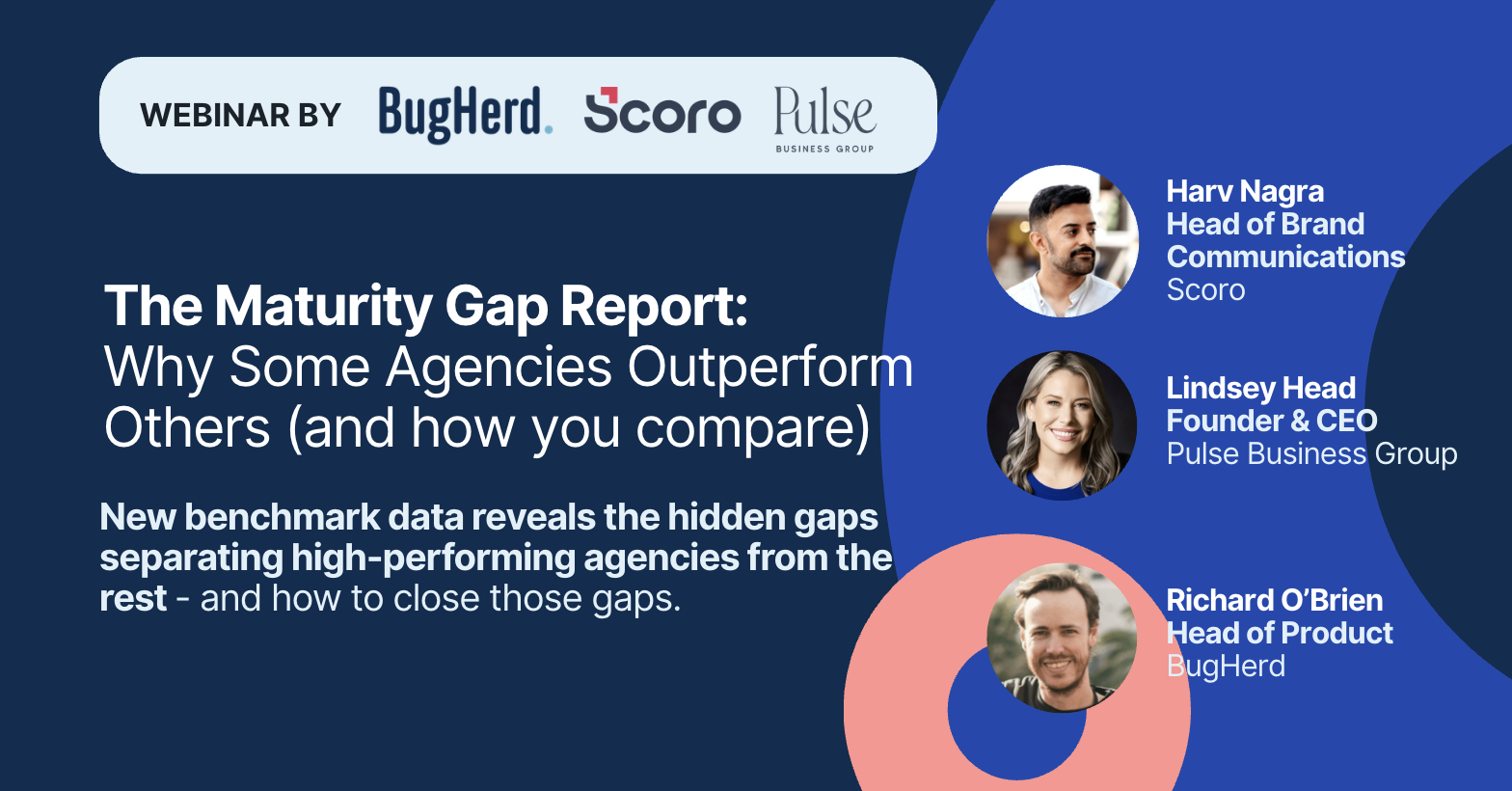
BugHerd's Head of Product Richard O'Brien hosted a very insightful session with Harv Nagra (Head of Brand Communications at Scoro and host of The Handbook: The Operations Podcast), and Lindsey Head (Founder & CEO of Pulse Business Group). Together they unpacked what the data from the Maturity Gap Report shows, where agencies are falling short, and what they can actually do about it.
The Research
What ‘Operational Maturity’ Actually Means
Operational maturity is not about how old your agency is, or how many people are on the payroll. A solo consultant can be highly mature, while a 200-person agency can still be running on chaos and gut instinct. Maturity is about how the business operates across five pillars: people, processes, technology, data, and growth strategy.
Operational maturity is mapped across five stages, with most agencies landing somewhere in stages one or two – here’s how Harv describes the stages:
Getting to stage three (just getting stable and consistent) is already a meaningful leap. Only a very small percentage of agencies ever get to stage five.
Where Most Agencies are Falling Short
Scoro's research found some striking gaps across the industry, and a ‘wake-up call’ confirming that in the current climate, agencies can't afford to wing it anymore. They have to run their businesses in a smarter, data-driven way.
Only 35% of firms have clearly defined roles.
That means nearly two-thirds of agencies are still in ‘everyone does everything’ mode. While that’s not unusual for early-stage businesses, it becomes a hard ceiling for growth. When there's no clarity around ownership, decisions bottleneck through one or two leaders and nothing moves without them.
Only 21% have documented best practices.
Nearly 80% of agencies are running on tribal knowledge; ie; information that lives in people's heads, in old Slack threads, etc. When that person leaves, so does the knowledge. When Harv Nagra moved into an Operations Director role at his past agency, one of the first things he did was build a centralized handbook covering systems, workflows, and processes, and it became one of the most valuable assets the business had for onboarding and scale.
Only 1 in 8 firms have meaningfully automated workflows.
People are still manually repeating tasks that could have been automated years ago. The rule of thumb that Lindsey Head teaches her clients: if you're touching the same process five times by hand, it should be automated. The tools have been available for years, and the barrier is usually mindset, not budget.
Only 13% use operational data to actually make decisions.
Lots of agencies collect data but far fewer act on it in real time. The most mature firms use live data to catch scope creep mid-project, manage profitability before the damage is done, and forecast capacity accurately, rather than doing a post-mortem once the project's already over.
The Timesheet Issue
One of the clearest dividing lines between high and low-performing agencies is time tracking. Low-performing firms either don't track time at all, or do it inconsistently, but without that data, you can't know whether a project is profitable, when you're over-servicing, when to hire, or how to price future work accurately.
Nobody loves timesheets but the data they generate is genuinely essential for running a smarter, more profitable business. The key is helping teams understand why the data matters, and not just mandating it from above.
Disconnected Tools
Only 1 in 5 agencies operate within a joined-up operational system. The rest are managing projects in one tool, budgets in another, timesheets somewhere else, and invoicing in yet another place entirely. That fragmentation creates:
- Duplicated effort across teams
- Stale data that nobody quite trusts
- Manual work just to get a clear picture of where things stand
- Operational blind spots that only become visible when something's already gone wrong
As agencies scale, disconnected systems stop being a workaround and start being a genuine liability, so having a streamlined workflow using tools that work together becomes immensely important.
Start Making a Positive Change Now
The agencies pulling away from the pack aren't necessarily winning more pitches or hiring faster - they're running smarter. Clearer roles, documented processes, real data, and systems that talk to each other.
The good news is you don't have to overhaul everything at once. Here are some practical starting points:
- Define roles before you hire: Map out the work that needs doing first, then figure out whether it needs a full-timer, a freelancer, fractional support, or an AI-enabled workflow. Clarity on the work comes before clarity on headcount.
- Start documenting: Pick a tool (eg. Notion, Coda, Loom, or Scribe), assign someone ownership, and start with one process at a time. The act of writing things down forces you to think critically about how the business actually operates, and it exposes gaps you didn't know were there.
- Track time, and explain why. Without timesheet data you can't know project profitability, spot over-servicing, forecast hiring needs, or price future work accurately. The key is helping your team understand why it matters, not just mandating it.
- Identify one repetitive process and automate it. As mentioned, if someone is touching the same task five times manually, it needs to be automated. Tools like Zapier have made this accessible for years.
- Work backwards from decisions to data. Rather than trying to track everything, identify the decisions you need to make regularly - resourcing, profitability, capacity - and figure out what data would actually help you make them better.
- Consolidate your tools over time. You don't need to rip and replace overnight, but the goal should be a joined-up system where projects, budgets, timesheets, and invoicing live together. Fragmented tools create fragmented visibility.
Operational maturity takes practice, and the agencies pulling ahead aren't doing anything revolutionary; they're just being consistent about the basics. Done well, those things compound over time into something that looks a lot like a competitive advantage.
More Information
- Take the Business Maturity Quiz to get your maturity score
- Read The Maturity Gap Report to see how you stack up against the best
- Connect with Harv Nagra from Scoro
- Subscribe to Harv Nagra's podcast, The Handbook: The Operations Podcast
- Connect with Lindsey Head from Pulse Business Group
Watch the Full Webinar

Marina Domoney
Marina Domoney is Marketing Communications Lead at BugHerd and a senior B2B marketer with 20+ years’ experience in SaaS and website delivery workflows. She’s worked closely with agencies, creative teams, and developers across countless web projects, giving her practical expertise in design and website feedback, approvals, and client collaboration.
Try BugHerd on your site
See feedback in context
Click anywhere to leave feedback directly on your website.






But don't just take our word for it.
BugHerd is loved by 10,000+ companies,
350,000+ users across 172 countries.
4.8/5
4.7/5
4.5/5
5/5
8.7/10
Sam Duncan 📱📏 🌱
@SamWPaquet
"@bugherd where have you been all my life??
We just migrated our bug tracking over from Asana and have at least halved our software testing time🪳👏📈. "
Ashley Groenveld
Project Manager
“I use BugHerd all day every day. It has sped up our implementation tenfold.”
Sasha Shevelev
Webcoda Co-founder
"Before Bugherd, clients would try to send screenshots with scribbles we couldn't decipher or dozens of emails with issues we were often unable to recreate."
Mark B
Developer
“A no-brainer purchase for any agency or development team.”
Kate L
Director of Operations
"Vital tool for our digital marketing agency.”
Paul Tegall
Delivery Manager
"Loving BugHerd! It's making collecting feedback from non-tech users so much easier."
Daniel Billingham
Senior Product Designer
“The ideal feedback and collaboration tool that supports the needs of clients, designers, project managers, and developers.”
Chris S
CEO & Creative Director
“Our clients LOVE it”
Emily VonSydow
Web Development Director
“BugHerd probably saves us
at least 3-4hrs per week.”