

BugHerd CEO and former agency owner, Stephen Neville, ran an extremely insightful webinar with Aurelio Volle, Co-founder and CEO of WP Umbrella, to discuss what transitioning to 100% code has meant for his business, his team and the future of digital agencies.
Since the transition, the company has more than doubled its revenue with largely the same team. But while AI has made development faster, it hasn't necessarily made running a business easier.
New bottlenecks have emerged, the role of developers has changed, and questions around quality, security, hiring and business growth have become more important than ever.
Key Takeaways
- AI agents can take over manual coding, but humans must remain accountable for the results.
- Faster development shifts bottlenecks to planning, review and decision-making.
- Clear project requirements and shared AI guidelines are more important than ever.
- Increased productivity doesn't automatically translate into business value.
- Security, quality assurance and ongoing maintenance require dedicated time.
- Experienced developers, critical thinkers and people who take ownership are increasingly valuable.
- Agencies need to rethink traditional hourly pricing models and focus on client outcomes.
- Successful AI adoption is as much about changing your mindset as it is about changing your technology.
A little background on WP Umbrella
WP Umbrella is a WordPress management and maintenance platform that helps web agencies manage multiple client websites from a single dashboard. Its features include website monitoring, backups, safe updates and security scanning.
At the time of the webinar, WP Umbrella had:
- Approximately 100,000 WordPress websites using its platform.
- Over 2 million in annual recurring revenue.
- A team of seven people.
- Virtually 100% of its production code written by AI agents.
The company had also more than doubled its revenue during the year with largely the same team. So, what can digital agencies learn from its experience?
12 Lessons for Digital Agencies Moving to AI-First Development
1. AI isn't removing the need for developers - it's changing their role
Until recently, AI coding assistants were primarily used to help developers write code faster. Developers would still write the code themselves, with AI helping them complete certain tasks along the way, but AI agents have taken this a step further.
At WP Umbrella, developers now spend their time managing AI agents rather than manually writing code. Their responsibilities have shifted towards:
- Deciding how something should be built.
- Designing the technical architecture.
- Giving AI agents clear instructions.
- Reviewing AI-generated code.
- Identifying potential problems.
- Ensuring the finished product is secure and reliable.
The ability to write code is no longer the only thing that makes a developer valuable. Knowing what to build, how to build it and whether it has been built correctly is becoming increasingly important.
The takeaway for agencies: Rethink how your developers spend their time. AI can handle much of the execution, freeing developers to focus on work that requires deeper technical knowledge and problem-solving.
2. Getting the project scope right is more important than ever
An AI agent can produce a large amount of work very quickly. But if it's working from unclear or incomplete instructions, it can just as quickly produce something that doesn't meet your needs.
Before handing a task over to AI, teams need to answer some important questions:
- What problem are we trying to solve?
- What exactly needs to be built?
- What does a successful outcome look like?
- What technical requirements need to be met?
- Could this change break something else?
- Are there any scenarios we haven't considered?
AI can also be used during the planning stage to challenge ideas, identify gaps and suggest alternative approaches. However, the final decisions about what to build and why should remain with the people who understand the business and its customers.
The takeaway for agencies: Invest more time in project briefs, client requirements and defining what good looks like. Better instructions lead to better AI-generated work and less rework.
3. AI doesn't eliminate bottlenecks — it moves them
One of the biggest misconceptions about AI is that faster execution will automatically make the entire business more efficient.
At WP Umbrella, the biggest bottleneck used to be writing code. Today, there are two new bottlenecks: reviewing code and deciding what to build next.
At one point, the development team had around 50 pull requests waiting to be reviewed, and developers were mentally exhausted from checking the amount of code AI agents were producing.
Product planning became another challenge. AI agents could build features faster than the business could plan them. WP Umbrella addressed this by hiring another product owner so that multiple features could be planned and developed at the same time.
The takeaway for agencies: Look at your entire workflow, not just development. If AI speeds up one part of the process, your next bottleneck could be internal QA, client feedback, approvals or project planning.
4. AI can do the work, but humans must own the outcome
AI can write code, create designs, draft content and generate recommendations. But someone still needs to make sure that work is correct, appropriate and ready to be delivered.
At WP Umbrella, much of the technical QA process is automated. However, humans remain responsible for the quality of what goes into production.
The amount of human review required can depend on the type of work being done. A minor front-end change may not require the same level of review as a change affecting website security or critical functionality. Knowing which work requires closer attention is where human experience becomes particularly valuable.
The takeaway for agencies: Make sure every piece of AI-generated work has a human owner. Using AI should never be an excuse for delivering poor-quality or unfinished work.
5. Give your AI agents shared rules and guidelines
If everyone in your agency uses different instructions, tools and standards, the work being produced can quickly become inconsistent. WP Umbrella has created a central repository where team members can access shared AI rules, skills and guidelines.
For agencies, these could include:
- Coding standards.
- Design systems.
- Brand and writing guidelines.
- Security requirements.
- Client-specific instructions.
- Quality assurance processes.
- Reusable AI skills and workflows.
Having these resources available also allows people outside the development team to take on work they previously couldn't.
The takeaway for agencies: Build a shared library of AI instructions and guidelines that everyone can access. The more context your agents have about your business, the more consistent their work is likely to be.
6. Don't waste time chasing every new AI tool
With new AI models and tools being released all the time, it's easy to feel like you're constantly falling behind, but constantly switching tools can become a distraction in itself.
Both WP Umbrella and BugHerd take a model-agnostic approach. Their teams aren't tied to one particular AI provider and can adapt as the technology evolves. However, the focus remains on building effective workflows rather than constantly searching for a slightly better AI model.
It's also important to understand the cost of using AI. While monthly AI subscriptions can offer excellent value, costs can increase significantly when businesses start using APIs to automate tasks at scale.
In some cases, it makes more sense to use AI to build a simple script that performs a repetitive task rather than paying for AI to perform that task every time.
The takeaway for agencies: Focus on what your AI tools help you achieve. Measure their cost, reliability and business impact rather than getting caught up in every new release.
7. Beware of the AI ego trap
One of the biggest dangers of AI is that it makes almost anything feel possible. You can build your own project management tool, create a CRM, develop a new application or automate dozens of internal processes. But should you?
The AI ego trap is the temptation to build or automate something simply because you can, rather than because it makes good business sense.
Before building something with AI, ask yourself:
- Does it solve a genuine business problem?
- Is there already a tool that does the job?
- How much time or money will it actually save?
- Who will maintain it?
- Could that time be better spent helping clients?
- Will it contribute to the growth of the business?
Building things is exciting, particularly when AI makes it so easy. But being busy building something doesn't necessarily mean you're moving your business forward.
The takeaway for agencies: Don't confuse what's technically possible with what's commercially valuable. Focus your AI efforts on activities that make a meaningful difference to your business and your clients.
8. Why are we working more when AI is supposed to save us time?
AI was supposed to give us more time. Yet many people are finding themselves working more than ever. This relates to an economic concept known as the Jevons paradox.
In simple terms, when something becomes cheaper, faster or more efficient, we often end up doing more of it rather than less.
Imagine that a developer can now complete five tasks in the time it previously took to complete one. Instead of using that extra time to reduce their workload, they take on another five tasks. The result is - more work, more responsibilities and potentially more stress.
The same thing can happen across an entire agency. AI makes it possible to produce more content, build more websites, launch more campaigns and develop more internal tools.
But producing more isn't always the answer.
The time saved through AI could instead be used to strengthen client relationships, improve existing services, explore new business opportunities or give employees a better work-life balance.
The takeaway for agencies: Be deliberate about how you use the time AI saves you. Increased productivity should lead to better outcomes, not simply longer working days.
9. Faster development makes security and quality even more important
AI makes it easy to produce large amounts of code in a short period of time, but every new feature, integration or piece of functionality introduces something else that needs to be maintained. It can also introduce new security risks. Just because your team can develop at a certain speed doesn't mean it always should.
At WP Umbrella, developers regularly set aside time for:
- Security audits.
- Penetration testing.
- Code reviews.
- Improving existing code.
- Identifying and fixing vulnerabilities.
- Maintaining the overall quality of the codebase.
The company introduced dedicated Friday morning sessions for this type of work and has since identified and resolved numerous previously unexploited vulnerabilities.
The takeaway for agencies: Reinvest some of the time saved through AI into website QA, security testing, accessibility, performance and ongoing maintenance. Faster delivery shouldn't come at the expense of quality.
10. Vibe coding is great for prototyping, but a prototype isn't a finished product
AI-powered development tools like Lovable have made it possible for people with little or no technical experience to build websites and applications.
Now, rather than spending hours trying to explain an idea, clients can now create a working prototype to demonstrate what they have in mind, and this could significantly reduce the time spent on initial discovery, wireframes and design discussions. However, creating something that looks good and appears to work is very different from building something that can securely and reliably support thousands of users.
Not every client will need an agency to take their prototype further, and a simple website may be sufficient for their needs. But businesses with more complex requirements will still need experienced professionals who understand hosting, security, integrations, performance and long-term maintenance.
The takeaway for agencies: Rather than seeing vibe coding as a threat, embrace it as part of the client discovery process. Help clients turn their ideas and prototypes into reliable, professional digital solutions.
11. AI is changing hiring decisions and the skills businesses need
As AI takes on more of the execution, businesses are starting to rethink the types of people they hire. At WP Umbrella, revenue more than doubled during the year without a significant increase in headcount. The company has since made additional hires to support future growth, but its hiring priorities have changed.
Some of the human skills becoming increasingly valuable include:
- Critical thinking.
- Attention to detail.
- Problem-solving.
- Technical expertise.
- Decision-making.
- Commercial awareness.
- Adaptability.
- Understanding customer needs.
- Taking ownership of work.
AI presents a particularly interesting challenge for junior developers. An experienced senior developer who knows how to manage multiple AI agents can now achieve significantly more than they could previously.
From a short-term business perspective, this can make hiring senior developers more attractive, but it also raises an important long-term question: If companies stop hiring junior developers, where will the next generation of experienced developers come from?
Businesses will need to find ways to develop junior talent in an environment where many traditional entry-level tasks can now be handled by AI.
The takeaway for agencies: Don't just think about how AI can reduce headcount. Think about the skills your business will need in the future and how you can develop those skills within your existing team.
12. Agencies need to rethink selling hours and start selling outcomes
For many digital agencies, this could be the biggest business challenge created by AI.
Traditionally, agencies have made money by selling hours or days of work. The longer a project takes, the more they can charge. But what happens when AI reduces a two-day development task to two hours? If you're charging by the hour, becoming more productive could actually mean earning less.
This is why agencies need to rethink how they price their services and communicate their value to clients. The conversation needs to shift from how long something takes to what it achieves.
Clients still need trusted partners who understand their business, guide their digital strategy, make sound technical decisions and help them achieve their goals.
There will also continue to be opportunities for agencies that specialize in handcrafted, bespoke digital experiences. In a market increasingly filled with AI-generated websites, this could become a valuable point of difference.
The takeaway for agencies: Explore value-based pricing, fixed-price projects, productized services and ongoing advisory relationships. Make sure your business model rewards efficiency rather than penalising it.
How can digital agencies prepare for an AI-first future?
Moving to an AI-first way of working isn't simply about giving everyone access to an AI tool. It requires a change in mindset, processes and company culture.
Not everyone at WP Umbrella embraced AI immediately. While the development team adopted it relatively quickly, other parts of the business were more hesitant.
Working alongside employees, demonstrating practical use cases and helping them understand the benefits played an important role in overcoming that resistance. For agency owners, it's also important to find time to think beyond the next client project or deadline.
Consider the following questions:
Not everything that made your agency successful in the past needs to change. The goal is to identify where AI can make your business stronger without losing sight of what makes it valuable in the first place.
How BugHerd is supporting AI-first agency workflows
Website feedback, bug tracking and QA are examples of processes where AI agents can help agencies reduce bottlenecks and repetitive manual work.
Traditionally, a client or team member would provide website feedback, a project manager would organize it, and a developer would interpret and implement the requested changes.
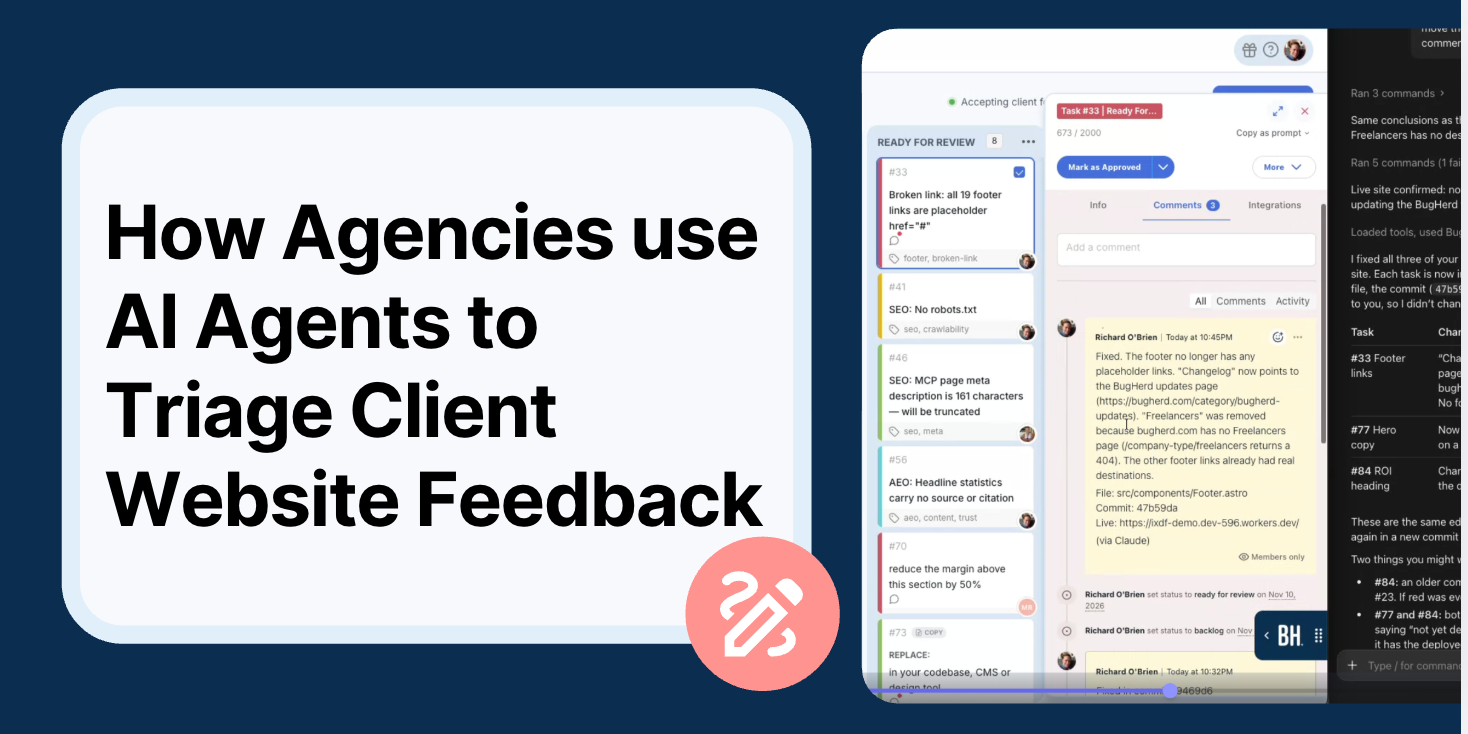
With BugHerd MCP (Model Context Protocol), AI agents can connect directly to BugHerd projects, tasks and client feedback.
A typical workflow could look like this:
- A client or team member pins feedback directly onto a website using BugHerd.
- BugHerd captures the comment, screenshot, page URL and relevant technical information.
- An AI agent accesses the feedback and its context through BugHerd MCP.
- The agent helps organize, prioritize or implement the requested changes.
- A human reviews the completed work before it's approved.
This reduces the manual work involved in managing feedback and implementing straightforward website changes, while allowing developers and project managers to focus on more complex tasks.
Importantly, humans remain in control of the quality and final outcome.
Just because you can doesn't mean you should
WP Umbrella's experience demonstrates how AI can help a small team achieve significantly more without dramatically increasing its size. But it also highlights the challenges that come with increased productivity.
More code needs to be reviewed. More features need to be maintained. More decisions need to be made. And someone still needs to take responsibility for the quality of everything being delivered.
For digital agencies, the biggest opportunity isn't necessarily to automate as much as possible, build more websites or reduce the size of their teams. It's to use AI to become better at what they do.
That means solving meaningful problems, delivering better outcomes, strengthening client relationships and building a business that can grow sustainably.
The question agencies should be asking isn't "What can we automate?" but "Where can AI help us deliver the most value?"
Watch the full webinar
Watch the full webinar for practical insights into AI agents, development workflows, human oversight, team structures, security and changing agency business models.
Frequently Asked Questions
What is an AI-first development workflow?
An AI-first development workflow uses AI agents to carry out much of the software development process, including writing code and performing technical checks. Humans remain responsible for planning, defining requirements, reviewing work and ensuring quality.
Can AI agents replace manual coding?
AI agents can handle much of the manual coding involved in software and website development. However, human expertise remains important for technical architecture, decision-making, security, quality assurance and ongoing maintenance.
What are the biggest challenges of AI-first development?
The biggest challenges include reviewing large amounts of AI-generated code, maintaining security, managing technical debt, preventing employee burnout and ensuring human accountability. Faster development can also create new bottlenecks around project planning and approvals.
What is the AI ego trap?
The AI ego trap is the tendency to build or automate things simply because AI makes them possible, rather than because they solve a genuine business problem. It can lead to wasted time, unnecessary costs and additional maintenance responsibilities.
What is the Jevons paradox in AI?
The Jevons paradox describes how increased efficiency can lead to increased consumption. In the context of AI, faster task completion can result in businesses taking on more work rather than reducing their overall workload.
Will AI replace web development agencies?
AI is changing how web development agencies operate, but businesses still need strategic advice, technical expertise, security, quality assurance and ongoing support. Agencies can use AI to improve efficiency while focusing on delivering better outcomes for clients.
How should digital agencies adapt their pricing models to AI?
Digital agencies can reduce their reliance on billable hours by exploring value-based pricing, fixed-price projects, productized services and ongoing advisory agreements. These approaches allow agencies to charge for the value they deliver rather than simply the time required to complete the work.
How can agencies use AI without compromising quality?
Agencies can maintain quality by defining clear project requirements, creating shared AI guidelines, establishing human review processes and dedicating time to security testing, website QA and ongoing maintenance.

Marina Domoney
Marina Domoney is Marketing Communications Lead at BugHerd and a senior B2B marketer with 20+ years’ experience in SaaS and website delivery workflows. She’s worked closely with agencies, creative teams, and developers across countless web projects, giving her practical expertise in design and website feedback, approvals, and client collaboration.
Try BugHerd on your site
See feedback in context
Click anywhere to leave feedback directly on your website.






But don't just take our word for it.
BugHerd is loved by 10,000+ companies,
350,000+ users across 172 countries.
4.8/5
4.7/5
4.5/5
5/5
8.7/10
Sam Duncan 📱📏 🌱
@SamWPaquet
"@bugherd where have you been all my life??
We just migrated our bug tracking over from Asana and have at least halved our software testing time🪳👏📈. "
Ashley Groenveld
Project Manager
“I use BugHerd all day every day. It has sped up our implementation tenfold.”
Sasha Shevelev
Webcoda Co-founder
"Before Bugherd, clients would try to send screenshots with scribbles we couldn't decipher or dozens of emails with issues we were often unable to recreate."
Mark B
Developer
“A no-brainer purchase for any agency or development team.”
Kate L
Director of Operations
"Vital tool for our digital marketing agency.”
Paul Tegall
Delivery Manager
"Loving BugHerd! It's making collecting feedback from non-tech users so much easier."
Daniel Billingham
Senior Product Designer
“The ideal feedback and collaboration tool that supports the needs of clients, designers, project managers, and developers.”
Chris S
CEO & Creative Director
“Our clients LOVE it”
Emily VonSydow
Web Development Director
“BugHerd probably saves us
at least 3-4hrs per week.”