

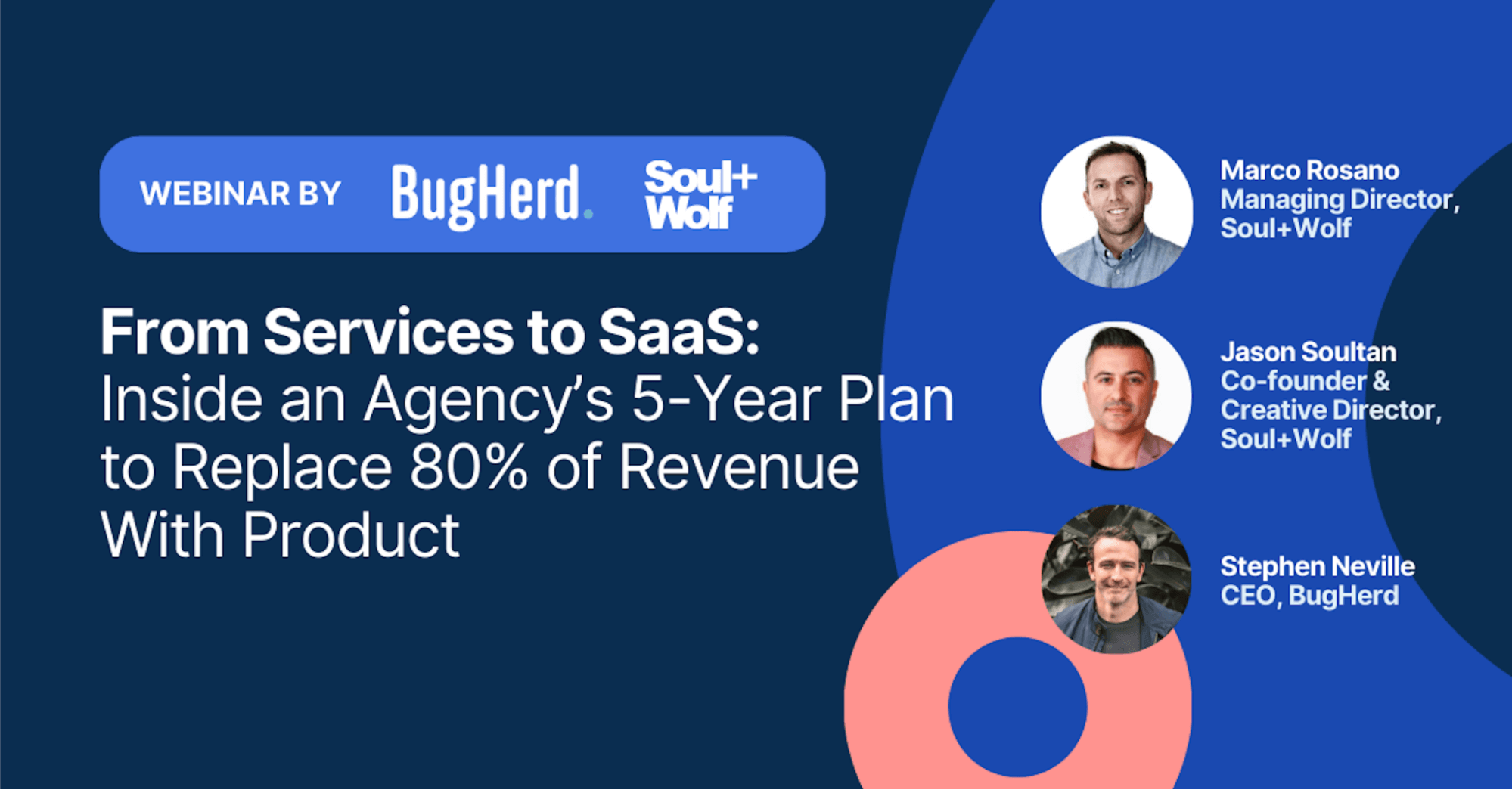
Over 15 years of building Australian-based digital agency Soul+Wolf, co-founders Jason Soultan and Marco Rosano have seen industry cycles, platform shifts, and now the acceleration of AI. This ever-changing landscape spurred them onto re-assessing their agency’s core offering, and pivoting towards a product-led agency.
BugHerd CEO, Stephen Neville (and former agency owner himself) featured Jason and Marco in a webinar where they shared the thinking, risks, structural changes, and practical lessons behind this shift, including what’s working, what’s hard, and what they’d do differently.
The moment the services model started to feel fragile
The shift in Soul+Wolf’s strategy wasn’t triggered by a lack of agency projects, or a dramatic collapse. It was something subtler.
Jason and Marco started noticing that there were so many instances where the team put in weeks of work into winning a project - strategy, conversations, positioning - only for the opportunity to disappear at the final stage.
Even if they had won it, the time invested in pitching would have eaten into the margin.
That’s when it clicked.
The cost of competition in agency land is enormous. Pitching. Proposal writing. Pre-sales strategy. Relationship building. And all of that before a contract is signed.
Even successful agencies can quietly bleed profitability through acquisition effort alone. And it wasn’t feasible to charge for developing a proposal when no other agencies were doing it.
Added to that were other factors:
- AI changing the value perception of execution work
- Increased competition from global talent
- Clients expecting faster turnaround at lower cost
- The constant pressure to “fill the pipeline”
And suddenly the traditional time-for-money model started to feel unstable.
Why the shift to product?
The target of 80% definitely raised eyebrows! Marco described it as a “shoot for the moon” target, but behind the number is something practical - recurring revenue creates stability.
Agencies often try to smooth peaks and troughs through retainers and SLAs, but selling a ‘product’ takes that further. Instead of constantly selling new projects, you build once and sell repeatedly.
What they’re actually building (and why it’s smart)
Every product Soul+Wolf is building comes directly from their existing expertise and recurring client problems.
Current initiatives include:
- A Shopify-NetSuite connector to accelerate integration work
- A Shopify automotive accelerator (robust storefront + private apps)
- A B2B-focused Shopify application
- An AI-driven automation tool built for their other business, TatLab
The pattern is clear … they’re productizing the friction they see every day.
Instead of rebuilding similar custom solutions repeatedly for clients, they’re retaining the IP and turning it into scalable tools.
That mindset shift alone changes everything.
The power of niching (without running out of money)
If there was one recurring theme in the webinar, it was this: Find a niche and go deep.
Niching doesn’t mean refusing good work. It means outward positioning and internal focus.
Because when you specialize:
- You see the same problems repeatedly
- You build pattern recognition
- You can validate product ideas quickly
- You reduce competition
- You justify stronger pricing
Soul+Wolf leaned into the intersection of Shopify, NetSuite, and specific verticals like automotive. That clarity made product opportunities obvious.
“If you're everything to everyone, then you're also nothing to no one; and you rarely see scalable patterns. If you’re deep in one space, patterns jump out at you.” - Marco Rosano
How to validate ideas before going all-in
To validate product ideas, Marco works closely with clients (sometimes physically from their offices) and listens deeply to operational pain points.
Instead of building quietly for six months, he tests ideas in conversation: “If we built something that solved this, would that matter to you?”
That immediate feedback loop is gold.
Soul+Wolf are not waiting for a polished product before going to market. They’re selling the concept early, gauging appetite, and adjusting accordingly.
That reduces risk dramatically.
Funding product development without killing the agency
Building product costs money, so how do you fund it without external investment?
Soul+Wolf’s answer - structural separation within the agency.
They created:
- A Services team
- A Support team
- A dedicated Product team
At the time of the webinar, there were 18 people in total; with one developer entirely dedicated to product work.
The Product team is protected - No “quick client tasks” and no borrowing for urgent deadlines.
They tried building product in downtime before, but it didn’t work because client work always wins. Dedicated cost centres and clear forecasting made the difference, and they treat product like a core initiative, not a side hustle.
The cultural shift: from “yes” to “filter”
Services culture often revolves around saying yes, whereas product culture requires filtering.
You can’t build every feature request. You have to prioritze for the broader market. For anyone embedded in a services culture, that’s a mindset shift.
Transparency internally helps keep your team focused. They understand the long-term direction and also gives team members the opportunity to opt into product roles. That openness reduces cultural friction.
And while it may seem tempting to pull someone from the Product team over to Services to help on a project, Soul+Wolf have learned how to push back client demands constructively, rather than disrupt the Product team. You can still achieve the client’s outcome, but just not always the way they initially demand.
The pricing shift: stop selling hours
Another major shift Soul+Wolf made before going heavy into product was moving away from time-and-materials pricing.
Instead of: 40 hours × rate = price
They now:
- Define the outcome
- Price the outcome
- Keep internal calculations private
When you expose hours and rates, clients debate inputs instead of value.
When you simply put forward the price, the focus is on the result.
If your solution saves money, makes money, or ensures compliance (and the cost of doing nothing is higher than your fee) the decision becomes easier.
Taking this approach may mean you lose some deals; but if you’re winning every deal, you’re probably underpriced.
The hardest lesson so far: cash flow discipline
The hardest part about investing in building a product is that it requires confidence and discipline. You’re tipping cash into something that won’t immediately return revenue, and there’s no guaranteed payoff.
It requires:
- Clear forecasting
- Time-bound expectations
- Strong belief in the opportunity
- Willingness to kill ideas that don’t gain traction
Soul+Wolf have killed products in the past when market appetite wasn’t there, and that discipline matters.
They’ve learned that if traction doesn’t appear within a reasonable window, they pivot, or stop. Not because the idea was bad, but because timing, positioning, or market readiness wasn’t there.
So … should your agency move to product development?
It may seem that certain agencies are better suited to product development than others, but it’s less about size and more about the approach you take.
If you’re feeling the strain of constant pitching, margin pressure, or unpredictable pipelines, pivoting towards product development may be the lever that shifts your agency from reactive revenue to recurring stability.
If you’re:
- Still deeply attached to time-and-materials
- Not focused on a niche
- Not tracking margins clearly
- Avoiding difficult positioning decisions
… then developing a product will feel chaotic. But if you:
- Understand your numbers
- See repeatable patterns
- Are willing to shift pricing mindset
- Can protect dedicated product time
… then the move becomes realistic.
The one thing you can do tomorrow
If you want a practical starting point, start with auditing your last 20 projects. Look for repetition.
- What problem keeps showing up?
- What custom solution have you rebuilt multiple times?
- What internal tool do you wish existed?
- What friction do clients consistently complain about?
That’s where your product idea will come from, rather than in random SaaS ideas, or following the latest trends. Your product development idea will come from the repeated pain inside your niche.
And once you identify that repeated pain, don’t jump straight to “build a full SaaS.” Start by systemizing it. Document the workflow and standardize the approach. Turn it into an internal framework or accelerator.
If you’ve solved something three or four times already, chances are you’re closer to building a product than you think.
The goal at this stage isn’t scale - it’s clarity. Clarity on the problem, the outcome, and who it’s for. Scale comes later.
Pivoting your agency towards more sustainable revenue
Soul+Wolf isn’t pretending that developing a product is easy. They’re still in the early stage of development, and they’re learning and experimenting. But they’re also being very deliberate.
They’ve productized parts of their agency.
They’ve structured dedicated teams.
They’re validating constantly.
They’re niching deeply.
And they’re moving toward a future where revenue compounds instead of resets every quarter.
Whether you stay services-first or move toward SaaS, one thing is certain: Agencies that adapt intentionally will outperform agencies that react late. If you’re an agency owner watching the market shift and thinking “we need a more stable model,” this is a grounded roadmap: start with your niche, start with the recurring problems you already see, and build from there.
Watch the full webinar here:
Soul+Wolf has been a BugHerd customer for many years and uses it to streamline client feedback, reduce revision cycles, and deliver websites on time and to budget.
If you would like to see how BugHerd can speed up your website review and QA loops book a 1:1 demo with one of our product specialists, or you can check it out yourself by starting a free 7-day trial (no credit card required).

Marina Domoney
Marina Domoney is Marketing Communications Lead at BugHerd and a senior B2B marketer with 20+ years’ experience in SaaS and website delivery workflows. She’s worked closely with agencies, creative teams, and developers across countless web projects, giving her practical expertise in design and website feedback, approvals, and client collaboration.
Try BugHerd on your site
See feedback in context
Click anywhere to leave feedback directly on your website.









But don't just take our word for it.
BugHerd is loved by 10,000+ companies,
350,000+ users across 172 countries.
4.8/5
4.7/5
4.5/5
5/5
8.7/10
Sam Duncan 📱📏 🌱
@SamWPaquet
"@bugherd where have you been all my life??
We just migrated our bug tracking over from Asana and have at least halved our software testing time🪳👏📈. "
Ashley Groenveld
Project Manager
“I use BugHerd all day every day. It has sped up our implementation tenfold.”
Sasha Shevelev
Webcoda Co-founder
"Before Bugherd, clients would try to send screenshots with scribbles we couldn't decipher or dozens of emails with issues we were often unable to recreate."
Mark B
Developer
“A no-brainer purchase for any agency or development team.”
Kate L
Director of Operations
"Vital tool for our digital marketing agency.”
Paul Tegall
Delivery Manager
"Loving BugHerd! It's making collecting feedback from non-tech users so much easier."
Daniel Billingham
Senior Product Designer
“The ideal feedback and collaboration tool that supports the needs of clients, designers, project managers, and developers.”
Chris S
CEO & Creative Director
“Our clients LOVE it”
Emily VonSydow
Web Development Director
“BugHerd probably saves us
at least 3-4hrs per week.”